
Zirconia Restorations
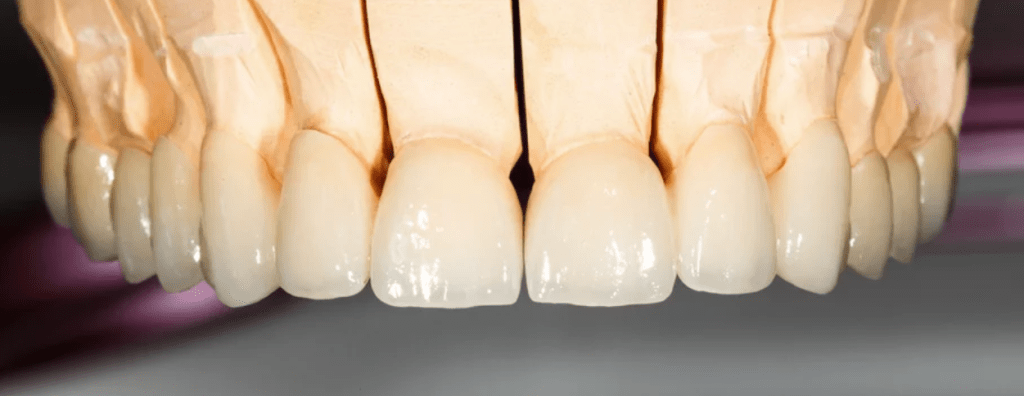
Full Contour Zirconia
For crowns, bridges, screw-retained implant crowns, inlays and onlays. Full Contour Zirconia is a monolithic zirconia material without porcelain overlay. For challenging situations such as bruxers, implant restorations, and areas with limited occlusal space, zirconia was designed to be a more durable, more esthetic alternative to metal occlusal PFMs or cast gold restorations. Zirconia has now evolved to exhibit improved translucency and color similar to natural dentition, thanks to advances in the formulation. Having color penetration all the way through the restoration prevents shade changes after the occlusal adjustment and ensures greater shade consistency.
Zirconia – The Material
The strongest ceramic available today is zirconia, a crystalline dioxide of zirconium. There is no glass phase in this material, so it cannot be etched. Depending on the temperature, zirconia can have several different crystalline structures. Different materials have been added to stabilize zirconium’s tetragonal crystalline structure at room temperature. Dentistry most commonly uses zirconia stabilized with yttrium (Y-TZP). In addition to tetragonal zirconia polycrystal, it is also called TZP.
Benefits of Zirconia
- Due to its similar color to natural teeth, it does not need to be opaque or masked like a metal substructure would.
- Zirconia’s opacity provides an advantage when blocking out underlying discolored teeth.
- Zirconia comes in a variety of shades, so the substructure can simulate dentin shades, greatly improving the final esthetics of a restoration.
- This material can be made to full contour providing the highest strength of any material.
- This material can be made as a substructure with porcelain layered over to offer incredible esthetics.
- Zirconia crowns are biocompatible. The smooth surface inhibits plaque accumulation overall, promoting a healthy tissue response.
- Zirconia is metal-free, providing an option for patients with metal allergies. Also, the metal-free material prevents darkening around the margin area. This is an excellent option for patients with a thin biotype.
- Through Computer-aided design and manufacturing (CAD/CAM), these restorations have a fast turnaround time and offer a precise fit. This allows for easy insertion and lowers seat time.
- Zirconia can be cemented in place using conventional cementation methods.
Types of Zirconia Restorations
Solid
These restorations are also known as monolithic zirconia. These restorations contain a high degree of stabilizing material, making these restorations extremely strong. They can withstand mastication forces and are very durable. This material is excellent for masking dark undesirable coloration. They require minimal occlusal clearance and create very low wear to opposing dentition. Often prescribed for patients who show signs of grinding and wearing down their teeth. This material is indicated for the following:
- Crowns
- Long Span Bridges
- Inlay/Onlay
- Implants
It is also highly suited for patients with the following situations:
- When tooth preparation is limited
- When high strength is required (1200 MPa)
- For patients who suffer from Bruxism
- When occlusal clearance is limited
- When allergies to other materials are present
Layered
These restorations are best suited for cases where esthetics are the primary goal. Usually, layered restorations are used to restore the anterior teeth; however, they can be used in the posterior if sufficient clearance is present. These restorations require a skilled technician knowledgeable in color and tooth anatomy. They consist of a zirconia frame/coping, and then porcelain is fused on top. These restorations are indicated for the following:
- Crowns
- Long span Bridges
- Implants
Best for patients who have the following requirements:
- High aesthetics is the number one concern.
- Matching a highly characterized natural tooth environment.
- When strength and durability are required (1200 MPa substructure).
- In cases that require the masking of undesirable underlying tooth color.
High Translucent
This type of zirconia is also referred to as Zirconia HT. These restorations are also metal free. They offer a high translucent appearance making them a great esthetic option. Their natural appearance makes them a highly desirable alternative over a porcelain-fused-to-metal (PFM) restoration. Unlike a PFM, these restorations will not expose an unnatural graying or metal show if a gingival recession occurs. They can be used in either the anterior or posterior regions. These restorations can transmit natural tooth colors and come in a variety of shades.
- Crowns
- Bridges of up to three units
- Implants
Best for the following types of cases:
- Those that require less preparation
- Cases where the optical characteristics of the restoration may be important to the patient.
- Those requiring strength and durability (590 -720 MPa)
Preparation Guidelines
- The ideal reduction is 1.0 mm (0.5 mm minimum)
- Preferred margins are shoulder or chamfer.
- Avoid undercuts. The axial walls need to be convergent.
- It is recommended to cut the preparation into three planes
- In preparations with subgingival margins, gingival retraction is necessary to achieve optimal impression quality.
Zirconia restorations can either be cemented or bonded, making it a great option that fits whatever seating processes you require.

Adjusting Zirconia
With its strength, durability, biocompatibility, and aesthetics, zirconia restorations are the ultimate restorative material. Because of zirconia’s unique strength, standard instrumentation can be ineffective in making adjustments chairside. Understanding the best instruments and techniques will make adjustments easier for both the clinician and the patient as well.
First, it is advised to only use instruments designed specifically for this high-strength material. Look for instruments that are specifically designed to finish and polish zirconia restorations. Failure to do this may leave the restorations dull and create an unfavorable surface area that can cause damage to natural opposing dentition.
For example, a diamond bur specifically designed for these restorations is needed when adjusting or finishing zirconia. Depending on the adjustment needed, a coarse grit or medium grit burr may be required. Minor occlusal adjustments may only need an abrasive rubber wheel. It is important to note that if a diamond is used to make an adjustment, the area must be polished to a smooth surface. Polishing to a smooth surface provides a better surface area than reglazing. By making sure all areas are polished, the surrounding dentition is protected from damage caused by a rough surface.